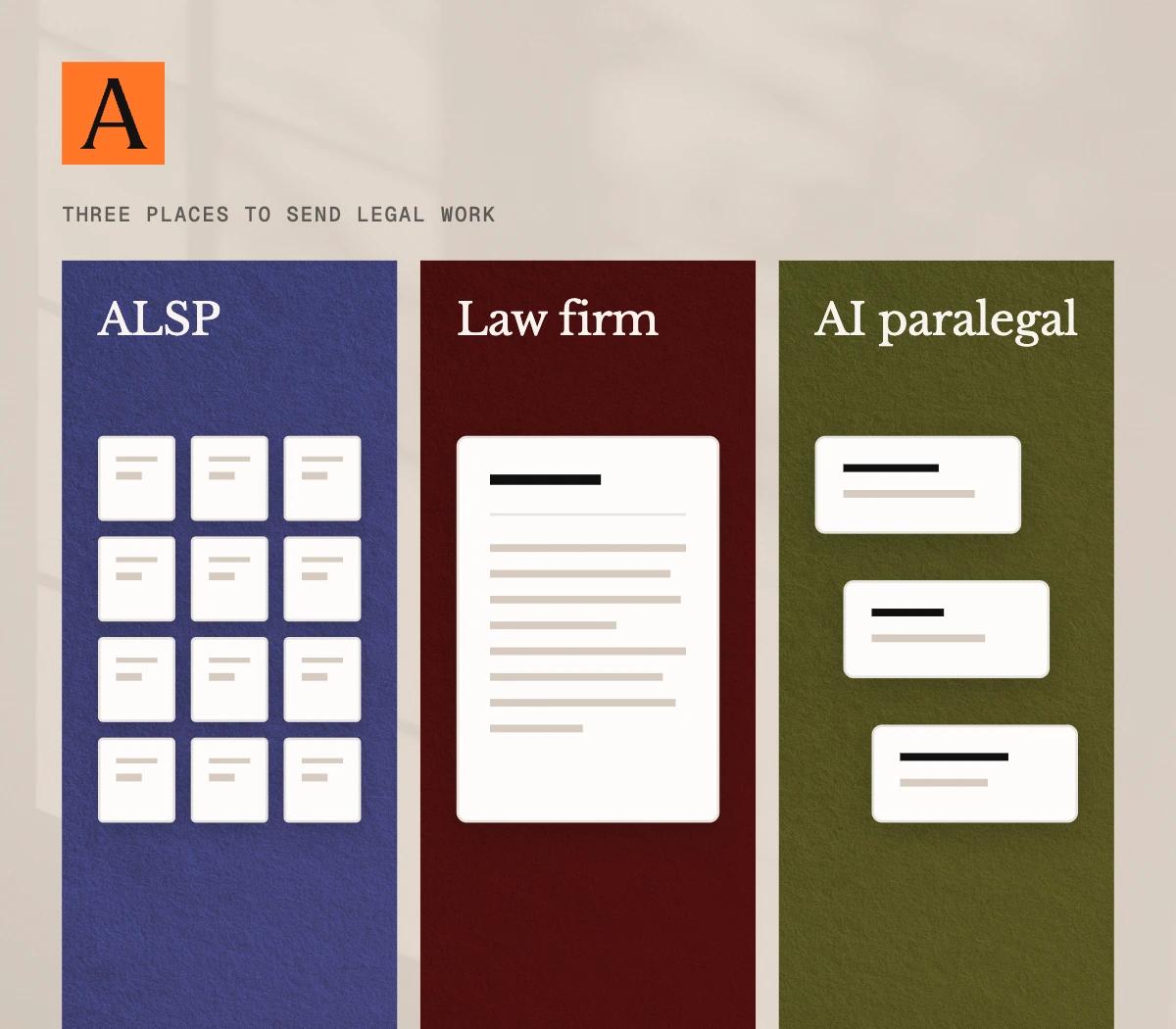
An alternative legal service provider (ALSP) is a company that provides legal services without being a law firm. It is one of three places to send legal work your own team cannot take on:
An ALSP runs volume work as a managed process. A law firm gives advice. An AI paralegal takes routine work as it comes up.
Each suits a different kind of work, and none suits all of it. We think the work should decide, and that many businesses will end up using more than one.
What does an alternative legal service provider do?
An ALSP takes on legal work that can be run as a process. Three kinds are common, among others.
- Work on one matter. Document review in a dispute, known as eDiscovery, and due diligence on a deal are the usual examples.
- A function it runs for you. Regulatory compliance and filings, handled month after month, are one example. This is what people usually mean when they talk about outsourcing legal work.
- People. A lawyer or paralegal from the provider joins your team for as long as the work lasts.
Alternative legal service providers also differ in who owns them. Some are independent companies, some are set up by law firms, and the Big Four accounting firms have legal arms of their own.
They are an established option. In a 2024 survey of corporate legal departments, 57% used an ALSP.
When is an ALSP the right choice?
When there is a lot of the work and it can be written down as a process. An ALSP is built to run the same task many times to an agreed standard.
A large review with a deadline is a good fit. So is a steady flow of one task, where you agree the scope once and the provider's team runs it from then on.
An ALSP is a poor fit in two cases. The first is general legal advice. Many ALSPs employ qualified lawyers, often called legal consultants, who give routine advice. They tend to work in niche areas of law, so they are used more for project work than as a general adviser.
The second is a small or irregular flow of work. A managed process has to be scoped, staffed and handed over before it starts. A few contracts a month rarely justify that.
When is a law firm the right choice?
When you need advice, when there is a dispute, or when a lawyer has to stand behind the answer.
What you pay for is expertise, a relationship and a track record. For a contested claim, or a deal that could change the company, that is worth the fee.
A law firm is a poor fit for routine work that repeats. Sending every NDA and renewal to a firm means paying for senior judgment on tasks that rarely call for it. It is not the work firms are built for.
If what you need is a senior lawyer for part of every week, that is a fractional general counsel. It is a different arrangement again.
When is an AI paralegal the right choice?
When the work is routine and arrives a piece at a time. An AI paralegal is an AI system that does recurring legal work end to end, the way a paralegal would.
It also works inside the tools your team already uses, such as your inbox, your shared drive and your e-signature account.
Alaro is ours. It is a self-serve AI paralegal, built by lawyers, for businesses and law firms. You send a task by email, Slack, Teams or WhatsApp. You do not need a kickoff call or a fully documented workflow first.
That suits the contract that needs reading against your playbook today, and the agreed document that needs signing, chasing and filing. Alaro also takes on larger jobs, such as reading a data room for due diligence.
Alaro handles routine execution and asks when instructions are missing or a request falls outside the rules you have set.
It is also self-serve. If you want a provider to design a function, staff it and run it for you, that is an ALSP's job.
We are an SRA-regulated legal AI company. Our in-house lawyers monitor quality and double-check work escalated internally. Specialist review of your matter by a regulated, insured lawyer happens on request, after you approve the scope and fee.
Which kind of work suits which?
Start from the piece of work and ask what it needs.
Do you have to choose one?
No. Among legal departments that work with ALSPs, two-thirds prefer to pick the best provider for each need over a single provider for everything.
Take a business with a small legal team. A law firm handles the dispute and the acquisition. An ALSP handles the large document review inside them. An AI paralegal handles the contracts and admin that arrive every day.
Whichever you use, ask who does the work, who checks it and who answers for it when it is wrong. Our questions to ask any AI legal vendor apply to all three.
FAQ
Do ALSPs give legal advice?
Some do, in a limited way. Many employ qualified lawyers who give routine advice in niche areas. Even so, ALSPs have a very small share of the market for legal advice. Legal support is the largest part of what an alternative legal service provider sells.
Do law firms use ALSPs themselves?
Yes. Some firms have set up an ALSP of their own, and others bring in an independent one to deliver part of a client's work. If it matters to you who does the work, ask your firm.
Will AI replace ALSPs?
Not soon, on the evidence so far. In the 2024 survey, law firms and legal departments both expected generative AI to be an advantage for ALSPs over the next three years. A minority expected to need them less at some point, as AI lets them do more of the work themselves.
Sources
- The Law Society, Leadership and Management Section, Alternative energy, by Alex Heshmaty, April 14, 2022.
- Thomson Reuters Institute, the Center on Ethics and the Legal Profession at Georgetown Law, and Saïd Business School, University of Oxford, Alternative Legal Services Providers 2025, January 28, 2025. Survey of 213 corporate law department respondents and 424 law firm respondents, September to October 2024.