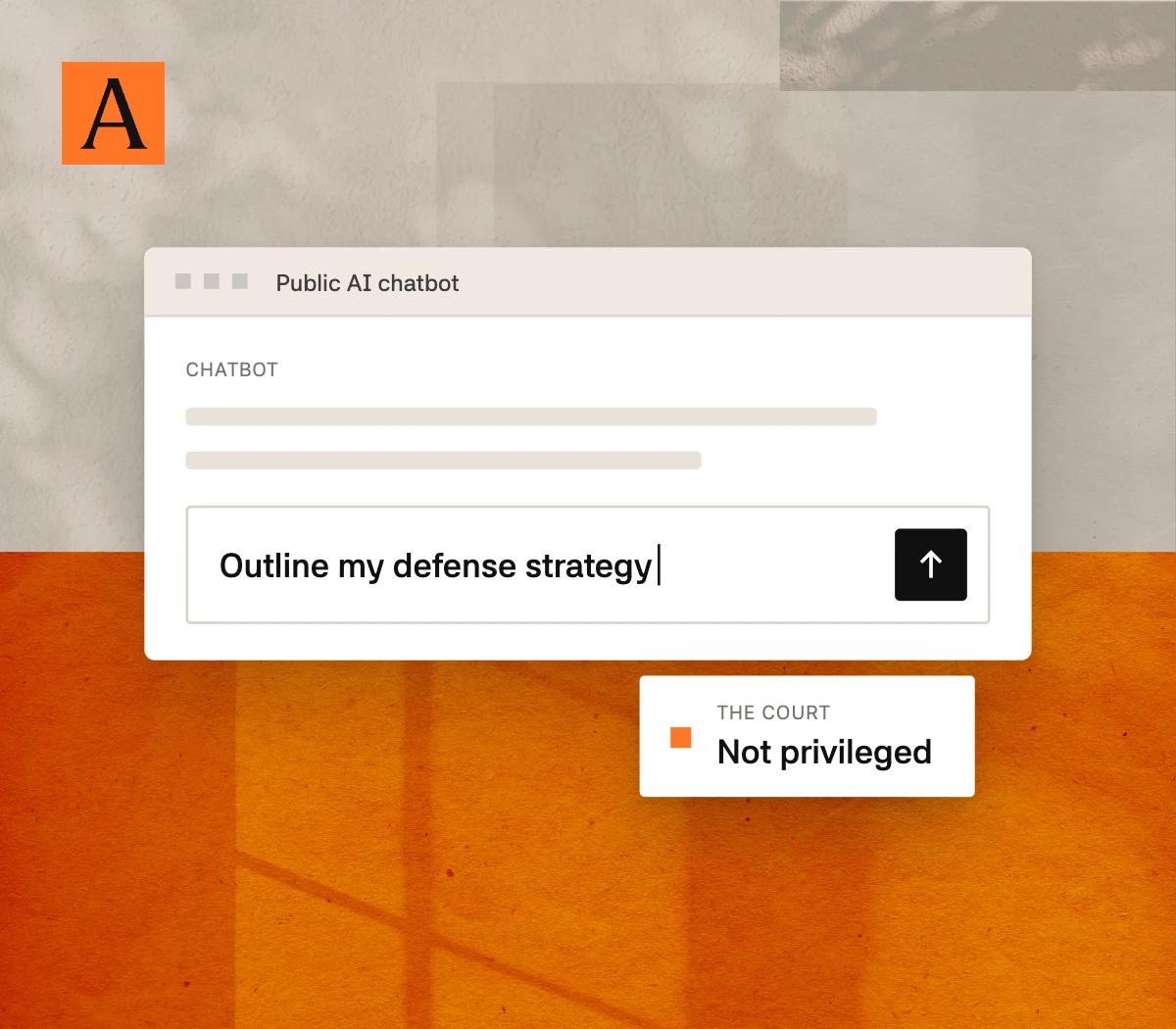
AI-assisted legal work can be privileged, but the answer depends on who used the tool, which tool it was, and whether a lawyer directed the work. In February 2026, a federal court in New York ruled in United States v. Heppner that a defendant's conversations with a public AI chatbot were not privileged. Prosecutors were allowed to read them.
The court did not write a new rule for AI. It applied the ordinary tests for privilege to a new kind of tool. That makes the ruling a practical guide to AI privilege, because any team can ask the same questions before legal work goes into an AI tool.
This article provides general information only and does not constitute legal advice. Whether privilege applies depends on the specific facts and the jurisdiction concerned.
What happened in United States v. Heppner?
A defendant used a public AI chatbot to think through his defense, and the court refused to treat those chats as privileged.
Bradley Heppner was indicted in October 2025 on fraud charges. He had used Claude, Anthropic's publicly available AI assistant, to prepare reports outlining his defense strategy and possible arguments. He did this without direction from his lawyers.
FBI agents searched his home and seized devices holding about 31 of these documents. He claimed privilege over them, and the government asked the court to rule that they were not protected.
Judge Jed Rakoff heard argument on February 10, 2026, and granted the government's request the same day. He held that the documents were protected by neither attorney-client privilege nor the work-product doctrine, which left them open to the prosecution.
On February 17 he issued a written opinion setting out his reasons. The sections below break that reasoning down, and the Harvard Law Review's account of the case sets out the facts in full.
Why were the AI chats not covered by attorney-client privilege?
They failed each of the three things attorney-client privilege requires: a lawyer, confidentiality, and the purpose of getting legal advice.
- There was no lawyer in the conversation. Claude is not an attorney, so the chats were not communications between a client and counsel.
- The chats were not confidential. The tool's privacy policy allowed the provider to collect what users typed, use it for training and disclose it to third parties, including regulators. The court found no reasonable expectation of confidentiality.
- They were not made to get legal advice from counsel. Heppner chose to use the tool himself, and the tool says it is not a lawyer.
Sending the documents to his lawyers afterward did not help. Material that is not privileged when it is created does not become privileged because a lawyer later receives it.
What about work product, the separate protection for material prepared for litigation? That claim failed too. The documents were not prepared by counsel or at counsel's direction, and they did not reflect counsel's strategy when they were made.
What did the Heppner ruling leave open on AI privilege?
Here's the catch. The ruling is narrower than many headlines suggested, and two questions remain open.
- AI use directed by a lawyer. The court suggested the result might have been different if Heppner's lawyers had told him to use the tool. In that case, the AI might have counted as an agent of counsel.
- Business tools with confidentiality terms. The case involved a consumer product on consumer terms. The court did not decide how a business tool with negotiated confidentiality terms would be treated.
Many commentators expect stronger terms to help a privilege claim. That is a prediction. No court had ruled on the question in the commentary we reviewed for this post.
Do all courts agree with Heppner?
No. On the same day as Judge Rakoff's ruling on AI privilege, a federal magistrate judge in Michigan went the other way in Warner v. Gilbarco. A plaintiff representing herself had used ChatGPT to prepare her case. The court held that her AI materials were protected work product, and that using ChatGPT did not waive that protection.
The two cases turned on different protections. Heppner was about attorney-client privilege, and Warner about work product, which is harder to waive.
Does the same reasoning apply in England and Wales?
Heppner does not bind courts outside the US. On AI privilege, though, the early signals in England and Wales point the same way for public tools.
In Munir, the Upper Tribunal warned that uploading confidential documents into a public tool such as ChatGPT breaches client confidentiality and waives privilege.
In April 2026, the Chancellor of the High Court, Sir Colin Birss, addressed the question in a speech to the City of London Law Society. He said the use of a public system cannot be assumed to be confidential. He saw little reason why a lawyer's use of a secure system would affect the client's privilege.
So what changes between a public tool and a secure one? Less than a simple label suggests. The risk depends on how a tool is configured and what its terms say. Consumer tools carry serious risk. Business tools carry less, though not none.
Here are the main authorities so far, side by side.
What should you check before legal work goes into an AI tool?
The courts' reasoning on AI privilege turns into five questions.
- Who is using the tool, and at whose direction? Work done by a lawyer, or at a lawyer's direction, stands on firmer ground than someone experimenting alone.
- What do the terms say? Check whether the provider can keep, read, train on or disclose what you enter. In Heppner, the privacy policy decided the confidentiality question.
- Is it a consumer account or a business one? A personal account on a public tool is the riskiest setup for legal material.
- What is going in? Keep advice from your lawyers out of public tools. Using AI to summarize meetings with counsel could put the privilege in that advice at risk.
- Does everyone outside legal know the rules? In Heppner, the documents were created by someone with no legal training, acting without advice. The same exposure exists wherever staff outside the legal team use AI tools on sensitive matters. A written AI policy, backed by short training on what may be entered, addresses it.
How does Alaro measure up against the court's questions?
Alaro is a self-serve AI paralegal, built by lawyers, and we are an SRA-regulated legal AI company. Our trust page sets out how we protect your work. Here is how that lines up with the three things the Heppner court looked at.
- Confidentiality. The consumer tool in Heppner could keep what users typed, train on it and disclose it. Our model providers work under zero data retention agreements. Your prompts and outputs are not retained by those providers, and nobody trains on your work. We encrypt your data when it is stored and when it is sent between systems, and isolation controls keep it separate from other customers' work.
- Direction and control. Heppner acted alone. With us, your playbook sets the limits, and Alaro asks before taking action outside your agreed boundaries. Your own lawyers can review the work and make the decisions. Access runs on SAML SSO, role-based permissions and audit logs.
- A lawyer when you need one. The court stressed that a chatbot is not a lawyer. Our in-house lawyers monitor quality and double-check work that is escalated internally. That is different from a lawyer reviewing your particular matter. When you want that, ask for a specialist review by a regulated, insured lawyer.
Why does this matter? These points answer the confidentiality and control questions the court asked. Whether privilege applies to a particular piece of work still depends on who asked for it, why, and where you are, so check your position with your own lawyers.
Reviewing Alaro for your team? You can request our security documentation from the trust page.
For the wider set of questions to put to any provider, see what to ask an AI legal vendor. New to the category? Start with what an AI paralegal is.
FAQ
Does using AI waive attorney-client privilege?
It can. Entering privileged advice into a public tool whose terms let the provider use or disclose it risks waiver. In Heppner, the court treated that as sharing the material with a third party. A secure tool used at a lawyer's direction is on firmer ground, though courts have not yet tested that fully.
Are ChatGPT conversations covered by attorney-client privilege?
Not by default. Privilege needs a lawyer, confidentiality and the purpose of getting legal advice. For the consumer tool in Heppner, the court found no reasonable expectation of confidentiality, because the privacy policy allowed collection, training and disclosure. Business plans come with different terms, so read the ones that apply to you.
Does Heppner apply to legal AI platforms such as Harvey and Legora?
Not directly. Heppner concerned a consumer chatbot used under consumer terms. Legal AI platforms are bought by firms and legal teams under business contracts, which is the situation the court left open. No court has ruled on it yet, so the answer turns on each platform's terms and on who directs the work. The same applies to us.
Does Heppner apply to lawyers' own use of AI?
The case was about a non-lawyer acting alone, so it did not decide that. In England and Wales, the Chancellor of the High Court has said he sees little reason why a lawyer's use of a secure system would affect the client's privilege. Lawyers still need to check each tool's terms.
Sources
- Harvard Law Review, United States v. Heppner, March 23, 2026.
- Gibson Dunn, AI Privilege Waivers: SDNY Rules Against Privilege Protection for Consumer AI Outputs, February 20, 2026.
- Cleary Gottlieb, Courts Grapple with Privilege Implications of AI, February 27, 2026.
- Proskauer, Michigan Federal Court Protects AI-Assisted Litigation Work Product, March 2, 2026.
- Maynard Nexsen, United States v. Heppner and AI Discovery: Confidentiality and Privilege Concerns, February 18, 2026.
- Courts and Tribunals Judiciary, Speech by the Chancellor of the High Court: Legal professional privilege in the Age of AI, April 22, 2026.
- Osborne Clarke, AI and privilege in England and Wales, October 23, 2026.