A non-disclosure agreement is usually the first document in any deal. Nothing gets shared until it's signed: not the product roadmap, the supplier's pricing or the data room. Each NDA is routine, but there are a lot of them, and NDA review ends up waiting in a queue.
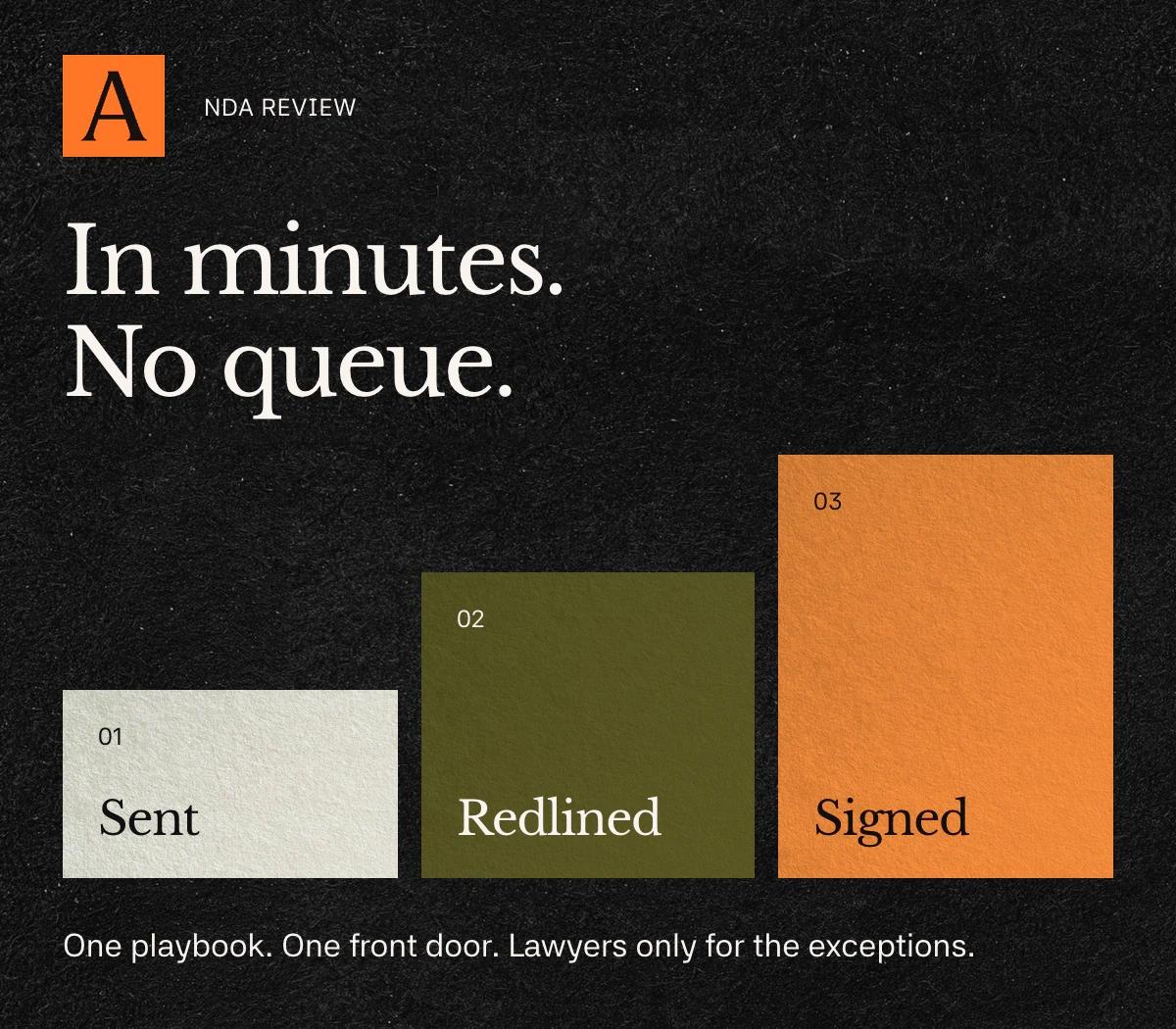
You get NDA review in minutes by taking that queue out of the process: one playbook, one front door, and lawyers only for the exceptions. Alaro, the AI paralegal for your entire business, works this way. At Antavo, the median time to a draft or redline was 15 minutes, and 97% of matters were turned around within the hour. Send it an NDA by email, Slack or Teams. It checks the NDA against your playbook, redlines it, chases the signature and files the signed copy. Your lawyers see only the clauses that need their judgment.
This guide follows one NDA from request to signature. It covers what to check, where lawyers step in, and how the main ways to get an NDA reviewed compare.
Why does NDA review end up in a queue?
NDAs pile up because each one is small, they never stop coming, and they all go through the same one or two lawyers. Sales wants one signed before a demo, procurement before a supplier call, and the founders before an investor meeting.
Requests come in from everywhere: a Slack thread, a forwarded email, a Salesforce ticket. Some get lost. Others wait behind work that actually needs a lawyer.
The legal part of a routine NDA is often quick. Most of the days go on waiting, chasing and back-and-forth. All that waiting blocks the work your lawyers were hired to do.
That was the picture at Antavo before it brought in Alaro. Every NDA and customer contract went to its CFO and its compliance manager.
How Alaro handles it: Alaro is the front door. Anyone in the business can send it an NDA directly, and legal stays in control of the positions it works to.
"I wanted all of our legal work in one place, so what we learn on one deal carries into the next. Alaro is that place."
What does an NDA review look like, start to finish?
Here is an illustrative example of a routine NDA run through Alaro.
What did the in-house team actually do? One lawyer answered one question about the non-solicit. Everything else was handled.
What should you check in an NDA?
Check every NDA against your playbook: the position you prefer and the fallback you'll accept for each clause. This NDA checklist covers the clauses that matter most on almost every agreement:
- Direction. Mutual or one-way, and whether that matches the deal.
- Definition of confidential information. Too broad and you can't work. Too narrow and it protects nothing.
- Standard exclusions. Information that is public, already known, independently developed or received from a third party.
- Permitted disclosures. Employees, advisers, affiliates, and disclosures required by law or a regulator.
- Term and survival. How long the obligations last, and whether trade secrets are protected for longer.
- Return or destruction. Including a carve-out for routine backups.
- Hidden extras. Non-solicits, non-competes, exclusivity or residuals clauses buried in a "simple" NDA.
- No license. Sharing information should never grant rights to it.
- Remedies. Injunctive relief, indemnities and any uncapped liability.
- Governing law and jurisdiction. Which law applies, and where any dispute is heard.
- Assignment. Whether either side can pass the NDA on, for example if it is acquired.
Each clause gets a standard position and approved fallbacks. Anything outside them goes to a lawyer, with the reason it was flagged.
How Alaro handles it: Alaro checks every NDA against these positions and flags anything outside them. No written playbook yet? That is where scoping starts. Alaro works from your team's own material: templates, precedents, past negotiations and the positions you've accepted before.
How long does an NDA review take?
A clean mutual NDA on your own template can be checked in minutes. An NDA on the counterparty's paper takes longer, especially when it contains hidden extras. The real delay is usually the time it spends waiting in someone's inbox.
Alaro starts when the request arrives. Antavo began with NDAs during its trial, and our findings show what that does to NDA turnaround. The median time to a Word draft or redline was 15 minutes, and Alaro turned around 97% of Antavo's matters within an hour.
When a clause does fall outside your playbook, Alaro sends it to your lawyer with a short note and a suggested position. Everything else keeps moving.
Why does this matter?
Each day an NDA sits unsigned is a day a deal, hire or partnership can't move.
How much does an NDA review cost?
It depends on who does the work, and on what is left for your team to do afterwards.
Here's how the main options compare.
How do you get NDAs back in minutes?
Speed comes from preparation more than from any single tool. The teams that turn NDAs around fastest tend to do five things.
- Agree on one playbook. Preferred positions, fallbacks and walk-away points for every clause above.
- Use one template. Push your own paper first, so most reviews start from a known draft.
- Have one front door. Every request goes to the same place, whoever sends it.
- Set escalation rules. Decide in advance which deviations need a lawyer and which don't.
- Close the loop. Route for signature, chase signatories and file the signed copy without anyone having to remember to.
How Alaro handles it: You agree on the playbook and the template once, during scoping. After that, Alaro is the front door. It applies your rules the same way every time, whoever sends the request, and it closes the loop through signature and filing.
The result? Lawyers see only the exceptions, and the routine work keeps moving without them.
Where Alaro fits
Alaro handles recurring legal work for in-house teams, and NDAs are a good place to start. Getting started works like bringing on a new hire. You scope the playbook, approval rules and escalation points together, then send work the way you already do. You can send the first request on day one by forwarding an email, without connecting any systems. The full picture is in what Alaro is and how it works.
The same approach applies to supplier agreements, MSAs and order forms. See how Alaro handles contract reviews.
NDAs are rarely the only thing on your desk. Whatever else is there, Alaro can probably help with that too. Browse everything Alaro can take on, or send it your hardest challenge.
Is it safe to send NDAs to an AI?
It depends on the provider, so check how your data is stored, who can access it and whether it trains models.
How Alaro handles it: Everything you send Alaro is encrypted in transit and at rest. Neither Alaro nor its model providers use your inputs or outputs for model training, and model providers operate under zero data retention agreements. Backend access runs on SAML SSO, role-based permissions and audit logs. You can have your data deleted on request. Full details are on the Alaro trust page.
Whichever provider you choose, ask how work is reviewed, how errors are caught and fixed, and what insurance and regulation stand behind it. Our guide to questions to ask legal AI vendors has the full list.
FAQ
Can AI review an NDA?
Yes, for routine checks against a clear playbook. Most AI NDA tools, and general ones like ChatGPT or Claude, stop at the analysis and hand the document back. An AI paralegal takes on the whole job, through signature and filing. A lawyer still makes the judgment calls on anything outside your playbook.
What should an NDA playbook include?
A preferred position, an acceptable fallback and a walk-away point for each key clause, plus clear rules on what goes to a lawyer. No playbook yet? That's fine. Alaro starts from market-standard positions and builds yours as you work together.
Which tools does Alaro use for NDAs?
The ones your team already uses: email, Slack and Teams for requests, Word for tracked changes and DocuSign for signature. Salesforce too. These are all existing integrations, so nobody has to log into anything new: loop Alaro into the conversation you're already having and it takes it from there.
How much does Alaro cost?
You can start free. Plans and typical costs are on the pricing page.