Not always. AI contract management software is a platform you buy, set up and move your contracts into. Most of it is contract lifecycle management (CLM) software with AI built in.
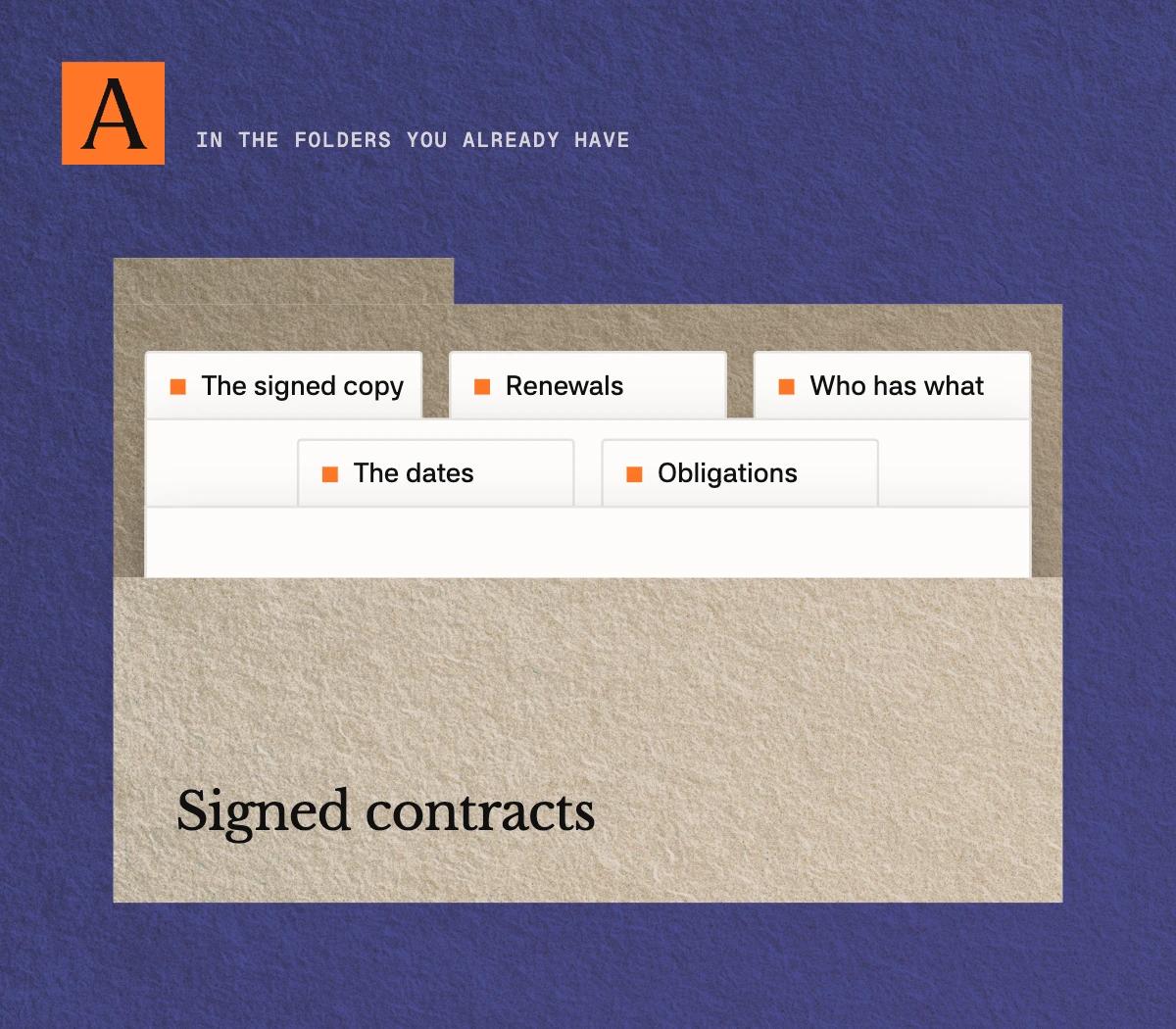
After signature, a small team mostly needs to find the signed copy, know the dates and act before a deadline. An AI paralegal can do that in the folders you already have. A platform earns its place when you sign many contracts and many people manage them.
What does CLM software do?
CLM software is a platform that runs a contract from first request to renewal in one place. A typical platform covers six stages.
- Request and drafting. The system builds a contract from a template.
- Review and approvals. The draft goes to the right people in a set order.
- Signature. The agreed version goes out for e-signature.
- Storage. The signed copy lands in a central, searchable repository.
- Tracking. Key dates, renewals and obligations sit against each contract.
- Reporting. Dashboards show what is signed and what is coming up.
What does AI add to contract management?
AI does the reading. It can pull the key terms and dates out of a contract and answer questions about it in plain language.
Someone used to type every date into a system by hand. AI can now do that step, with or without a CLM.
What does a small team need from contract management after signature?
A small team needs five things once a contract is signed.
- Find the signed copy. The final version with every amendment, in one known place. World Commerce & Contracting found that, on average, contract-related data is scattered across 24 different systems. That makes it very hard to keep track of commitments or to make decisions in time.
- Know the key dates. Start, end, renewal, break dates and price reviews.
- Hear about renewals in time. The date that matters is the notice deadline. A contract that renews on January 1 with 60 days' notice has to be canceled by November 2. Check how the clause counts days and how notice must be sent.
- Keep track of obligations. What each side promised, such as service levels, payment terms and reports.
- Know who has what. What is out for signature and what is waiting on whom.
Running this from a shared drive and a spreadsheet is common. ALM and Bloomberg Law surveyed corporate counsel in late 2022 and published the results in April 2023. More than half had no single platform for contracts or used general document systems.
When is a CLM worth buying?
A CLM is worth buying when the process itself has become the problem. That usually means high volume, many hands, or both.
- Many contracts of the same kind. Sales or procurement raise them weekly from a template.
- Approvals that must be enforced. Several teams sign off in a fixed order, and you need the record.
- A portfolio you report on. The board or an auditor asks about all your contracts at once.
- Someone to own the system. One person keeps the templates, workflows and data in order.
If that describes your team, buy one. A common process and a central record are what a CLM is for. When you compare contract management software for in-house counsel, test it on those points.
A platform costs money and time before it gives anything back. One vendor that publishes its prices starts at $450 a month, billed annually.
When is a CLM not worth buying?
A CLM is not worth buying yet when one or two people handle your contracts and the trouble is follow-through.
- Your signed contracts fit in a shared drive, even an untidy one.
- Nobody has time to configure a system or keep it current.
- The misses are simple. A notice date passed, or nobody could find the latest amendment.
A platform organizes the work. Someone still has to run it and act on what it shows.
So what changes with AI? The reading, the reminding and the chasing no longer need a platform around them. That is where AI helps a small team most.
How do you manage contracts with AI without a CLM?
An AI paralegal reads the contracts where they already live, keeps the dates and follows up on the next step.
Alaro is a self-serve AI paralegal, built by lawyers. You send it work by email, Slack, Teams or WhatsApp. Here is how it covers the five needs.
- The signed copy. Alaro gets the agreed version signed and files the signed copy wherever you keep your contracts, such as Google Drive. It can also find the one signed contract you need and explain what it says.
- The dates. Point Alaro at a folder, a contract system or your inbox. A connected system needs the right permissions, and you decide what Alaro can read or change. It pulls out notice periods, break dates, renewal windows and response deadlines, each tied to its contract.
- Renewals. You choose the lead time, and reminders arrive in your inbox, in Slack or in your Google Calendar. Before you renew, Alaro puts this year's terms next to last year's, points out each change and can negotiate new terms.
- Obligations. Ask for a one-page summary of any contract. You get the key terms, risks and obligations, linked back to their clauses.
- Who has what. Every request you send joins a live tracker. It shows who each document is with, what is agreed and what is outstanding.
If you decide to leave, Alaro drafts the notice, you approve it, and Alaro sends it the way the contract requires. The decision stays with you.
How does an AI paralegal compare with AI contract management software?
Here are the two side by side.
What does Alaro cost?
You can start free, with US$100 in credits. After that, monthly plans start at US$100 a month plus VAT. Your team shares one balance, and unused credits roll over.
What a task uses depends on its scope, complexity and revisions. Credits pay for work done and a subscription pays for a platform, so the two prices do not compare directly.
Where do you start with organizing your contracts?
Start with the contracts you already have, whatever you buy later.
- Put the signed copies in one folder. Include amendments and order forms.
- Get the dates out. For each contract, note the end date, the renewal terms and the notice deadline.
- Put the notice deadlines in a calendar. Leave enough lead time to act.
The result? You know what you hold, and you can judge a platform, or AI without one, against your real volume.
Would you rather hand those steps over? Point Alaro at your contracts and it will show you what is coming up. You can start for free.
FAQ
Is a spreadsheet enough for contract management?
For a small number of contracts, yes, if one person owns it and the notice deadlines are also in a calendar. A spreadsheet fails quietly. Nobody updates it after an amendment, and it cannot remind anyone.
How long does CLM software take to set up?
It depends on scope. One vendor's own guide says a single repository or one templated workflow can go live in days to a few weeks. It puts several workflows with integrations at a few weeks to a few months.
Does Alaro work with a CLM you already have?
Yes. Alaro can work in Ironclad, for example, with the access you provide, and your CLM stays the contract record. Agree which one owns each step, so the process does not create duplicate records. Our Alaro vs Ironclad comparison sets out where each fits.
Can AI get a contract date wrong?
Yes. AI can misread a clause, in AI contract management software or in an AI paralegal's work, so check the dates that carry real money against the contract. Alaro ties each date to its contract, and its summaries link back to the clause.
Our trust page sets out the checks we run to catch mistakes.
Sources
- World Commerce & Contracting, Contract Management: An Overlooked Driver of Business Agility and Financial Performance, August 2025.
- Bloomberg Law and ALM, 3 out of 4 In-House Counsel Dissatisfied With Existing Contract Workflow Technology, published April 12, 2023. The survey was run in late 2022.
- ContractSafe, Pricing, read November 17, 2026.
- Ironclad, CLM Implementation Time: What to Expect (and What Slows You Down), September 16, 2026.