Who is responsible when AI legal work is wrong? In the leading court decisions and regulatory guidance so far, the answer has been the people who used the tool.
Courts have held a business to what its chatbot said, and lawyers to what they filed. An AI tool's own terms can leave the checking with the user as well.
By November 16, 2026, a public database of court and tribunal decisions involving AI-fabricated content listed 2,306 cases worldwide.
This article provides general information only and does not constitute legal advice. Who is responsible when AI legal work is wrong in a particular case depends on the facts, the contract and the jurisdiction concerned.
Is the user responsible when AI legal work is wrong?
In the decisions so far, yes. Courts have looked to whoever relied on the output or sent it out under their name, and that includes businesses.
In 2024, a Canadian tribunal heard a claim over wrong refund information given by an airline's website chatbot. The airline argued it could not be liable for what the chatbot said. The tribunal disagreed and held the airline responsible for all the information on its website, chatbot included.
It is not only companies and lawyers who get caught. The database above attributes 1,323 of its cases to people representing themselves and 917 to lawyers.
So what changes for a business? Very little. A contract, notice or reply drafted with AI still goes out in your company's name.
What do courts and professional rules say about lawyers?
Both say that a lawyer who uses AI still has a duty to check the work.
The best-known US case is Mata v. Avianca. In 2023, a federal court in New York imposed a $5,000 penalty on two lawyers and their firm. They had cited court opinions that an AI chatbot had invented, then stood by them.
The judge saw nothing inherently improper in using a reliable AI tool for assistance. The failure was in the checking.
In England and Wales, the Divisional Court took the same view in 2025, in a judgment on two cases known as Ayinde and Al-Haroun. Lawyers who use AI for research have a professional duty to check it against authoritative sources before they use it in their work.
The court compared this to relying on a trainee's work. It referred lawyers in both cases to their regulators.
Does responsibility stop with the individual lawyer?
No. The same judgment said people with leadership responsibilities, such as managing partners, must take practical steps. Everyone providing legal services has to understand their duties when using AI.
The Solicitors Regulation Authority (SRA) tells firms the same. A firm remains responsible and accountable for the outputs of the AI it uses. It cannot delegate that accountability to an IT team or an outside provider.
In the US, the American Bar Association's Formal Opinion 512 applies lawyers' existing duties to generative AI. Our guide to questions to ask legal AI vendors covers it.
What does the AI vendor answer for?
It depends on the contract, so there is no single answer. Guidance written for law firms suits any buyer here. It says to make sure it is clear when a technical error is the provider's responsibility and when it is the user's.
Here's the catch. Some terms leave the checking with the user.
The consumer terms of one widely used AI assistant say that output may not always be accurate. Users must evaluate it, with human review where appropriate, before using or sharing it.
Business contracts differ from consumer terms, so read the one that applies to you.
Have the courts gone further? A 2026 Chambers and Partners article found that no court had held an AI tool or its maker liable for a flawed contract draft. That may change.
How do you lower the risk before anything goes out?
Decide who checks the work, and when, before you delegate the first task. Four steps cover most of it.
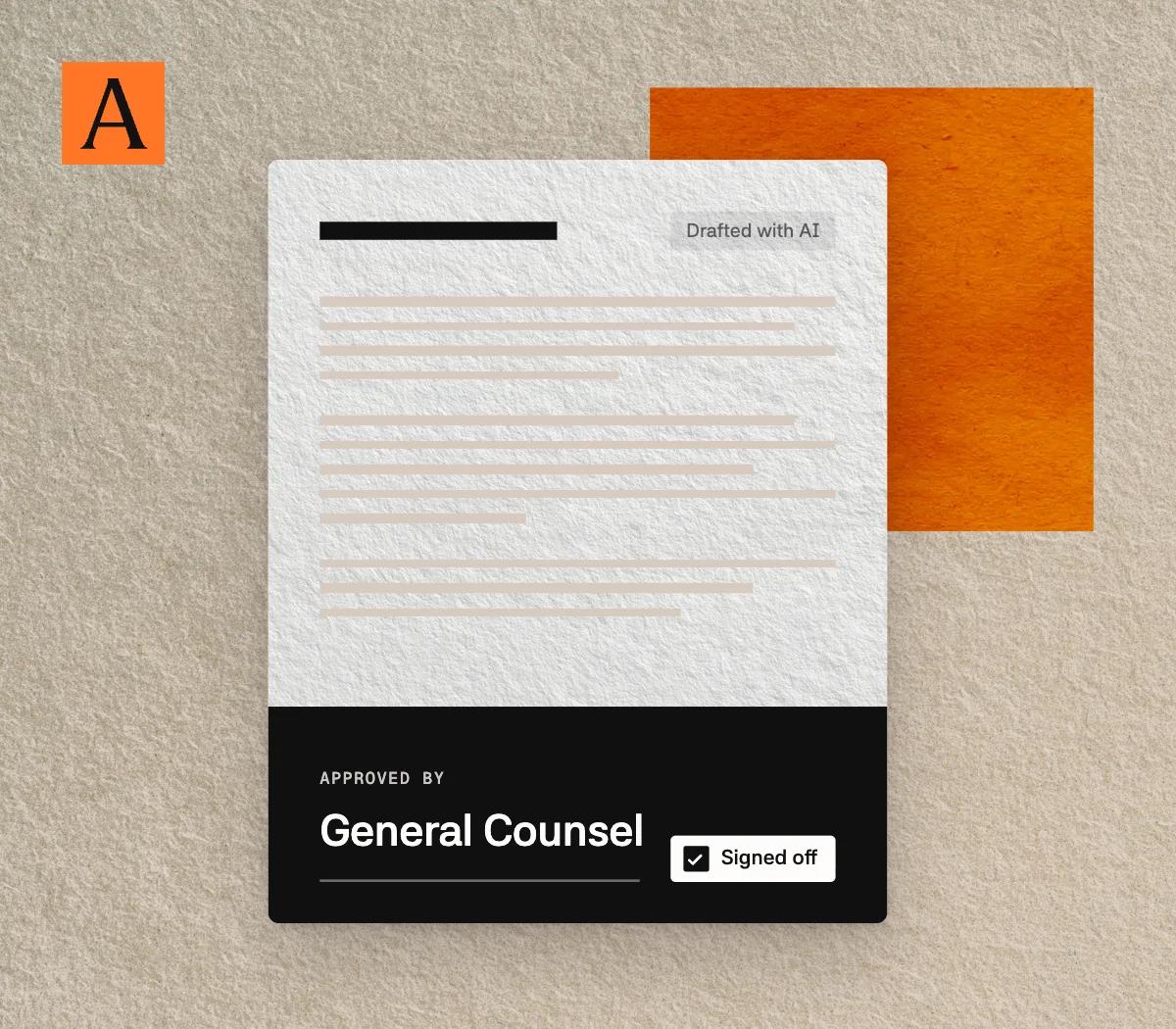
- Name the person who approves. Every document that leaves the business needs someone who signs it off.
- Check against the source. Compare the output with the documents and authorities it relies on.
- Match the review to the stakes. Routine work on agreed positions needs less review than one-off, high-stakes advice. That belongs with a lawyer.
- Check the final version. Compare it with what was agreed before it is signed, sent or filed. Alaro does this as a final sense check.
Who decides and who checks when you work with Alaro?
You keep the decisions, and the work is checked in three ways. Alaro is a self-serve AI paralegal, built by lawyers, and we are an SRA-regulated legal AI company.
- You keep the decisions. Alaro works within your instructions and asks before taking action outside your agreed boundaries. You keep the decisions about strategy, risk and approval. Your own lawyers can review the work.
- We run checks on the work. Source checks, automated evaluations and ongoing monitoring help detect and correct hallucinations. They do not make Alaro infallible. AI can be confidently wrong.
- Our in-house lawyers monitor quality. They also double-check work that is escalated internally. That is different from a lawyer reviewing your particular matter. It does not mean a lawyer approves every output before delivery.
- A lawyer reviews your matter when you ask. You can request specialist review by a regulated, insured lawyer. You approve its scope and fee before it starts.
Here's how that plays out. Our customers divide the work in different ways.
- At Paul Hastings, the deal team owned the due diligence report and its conclusions. It reviewed our proposed changes before sharing its work with the client.
- At Antavo, the CFO or the compliance manager approves every final version before signing. Human lawyers review our work only when Antavo requests it.
- For Emergence Ventures, a senior fund lawyer checks every review under that engagement's arrangement. The partners make the final call on each commitment.
Those are each customer's own arrangements. Specialist lawyer review is not included automatically in our self-serve plans.
Where are the limits of our answer?
There are three, and a general counsel deciding whether to buy should see them first.
- Lawyer review is not automatic. An AI-generated output should not be assumed to have been checked by a lawyer. Specialist review has its own scope and fee.
- Some work belongs elsewhere. For one-off, high-stakes advice, ask for a specialist lawyer, through us or your own counsel. Mostly bespoke work gives Alaro few recurring patterns to work from.
- The platform has its own agreement. If you use the platform as a registered user, a separate agreement between your organization and us governs that use.
You can start free with one routine task and judge the result yourself. Our trust page sets out how we protect your work, and What is Alaro? explains when a lawyer gets involved.
FAQ
Does blaming the AI tool work as a defense?
It has not so far. In the decisions above, the airline, the lawyers and their firm each answered for what the tool produced. Courts deciding who is responsible when AI legal work is wrong have looked to the person who relied on it.
Does insurance cover AI legal mistakes?
That depends on the policy. Guidance for law firms in 2023 described the insurance market's approach to legal AI as still emerging. Ask any provider what insurance and regulation stand behind its work.
If a law firm uses AI on client work, who answers to the client?
Under guidance for solicitors in England and Wales, the firm does. A firm that uses a third-party chatbot to give initial legal advice remains responsible for any errors in that advice. We make the same point about an AI paralegal.
Sources
- Civil Resolution Tribunal of British Columbia, Moffatt v. Air Canada, 2024 BCCRT 149, February 14, 2024.
- United States District Court, Southern District of New York, Mata v. Avianca, Inc., Opinion and Order on Sanctions, June 22, 2023.
- Courts and Tribunals Judiciary, Ayinde v London Borough of Haringey and Al-Haroun v Qatar National Bank [2025] EWHC 1383 (Admin), June 6, 2025.
- Solicitors Regulation Authority, Risk Outlook report: The use of artificial intelligence in the legal market, November 20, 2023.
- American Bar Association, ABA issues first ethics guidance on a lawyer's use of AI tools, July 29, 2024.
- Chambers and Partners, AI Drafted the Contract: Who Is Liable When It's Wrong, October 27, 2026.
- Damien Charlotin, AI Hallucination Cases Database, figures as of November 16, 2026.
- OpenAI, Terms of Use, effective January 1, 2026.