Legal operations is everything that helps a legal team run well, apart from the legal advice itself. It covers how requests arrive, how work is tracked, what it costs and which tools carry it. A lean in-house team can cover the essentials with five basics and no extra hire.
Most guides to legal operations assume a department with an operations team of its own. This one is written for the sole general counsel and the team of two or three. It is also for anyone who covers legal work alongside another job, whether in finance, operations or as a founder.
What is legal operations?
Legal operations, or legal ops, is the business side of a legal team. It deals with process, people, money, data and technology, so that lawyers can spend their time on legal work.
The people who do it are often described as the chief operating officers of the legal team. They keep the department running so the lawyers can get on with the law.
These are the common areas of legal operations, as the profession's own framework maps them.
Here's the catch. That map describes a large department. A team of two cannot work on twelve areas at once, and it does not need to.
Why does legal operations matter more on a small team?
Because the work keeps growing while the budget does not, and a small team has nowhere to put the difference.
In a 2025 Thomson Reuters Institute survey of 128 US legal department professionals, 81% reported rising matter volumes. Yet 55% reported flat or shrinking budgets, and more than half said their department was already under-resourced.
Chief legal officers feel the same squeeze. Among 1,049 participants in a 2026 survey, operational efficiency was the top strategic initiative, while budget and resource constraints were the top barrier to success.
A large department can spread that gap across many people. A team of two cannot. The only thing left to change is how the work moves, which is why legal operations matters most to a small team.
Do you need a legal operations manager?
No, a small team can start without one. A legal operations manager runs a department's processes, budget, vendors and technology, and the role becomes a full-time job as a department grows.
Many teams run it without one. In the same survey, nearly half of the people leading legal operations were general counsel who had been handed the job.
A small department benefits even when the role is part-time. The gain comes from someone owning how the work runs, however few hours they give it.
Once one person decides where requests go and keeps track of them, the team stops relying on memory and nothing waits in a forgotten inbox. On a lean team, that is how legal operations starts.
Which parts of legal operations should a lean team set up first?
Start with the five basics that remove the most daily friction.
Set them up in that order. One place for requests and one tracker stop work from going missing. The playbook, the calendar and the numbers all build on the record those two create.
Keep each one small. A playbook can begin as a single page for your most common contract, with a preferred position and a fallback for each clause.
What legal operations software does a small team need?
Less than most vendor lists suggest. A shared mailbox or channel, a spreadsheet, a folder of templates and an e-signature tool will carry a small team a long way.
Buy dedicated legal operations software when the simple version breaks. A missed renewal is one sign. Another is that nobody can say how many requests came in last month.
So what changes when you buy? Less than you might hope at first. Any system needs someone to keep it up to date, and on a small team that someone is usually a lawyer.
Our view is simple. A small team should buy as little software as it can get away with. Tools are rarely what is missing. Someone to keep them running is.
How does Alaro help a lean team run legal ops?
Alaro is a self-serve AI paralegal, built by lawyers, that takes on the operations side of legal work. Here is how it handles the first four basics.
- Requests. Send or forward a request by email, Slack, Teams or WhatsApp. As your legal front door, Alaro handles what it can and routes the rest to the right person.
- Tracker. Every request Alaro takes on joins a live tracker, kept current as the work moves. Nobody updates it by hand.
- Playbook. No written playbook yet? Alaro can start from your templates, precedents and past negotiations, then keep the playbook current as your positions change.
- Renewals. Alaro tracks renewals and notice periods and sends reminders well before each window closes.
What changes in a week, and what stays with your lawyers?
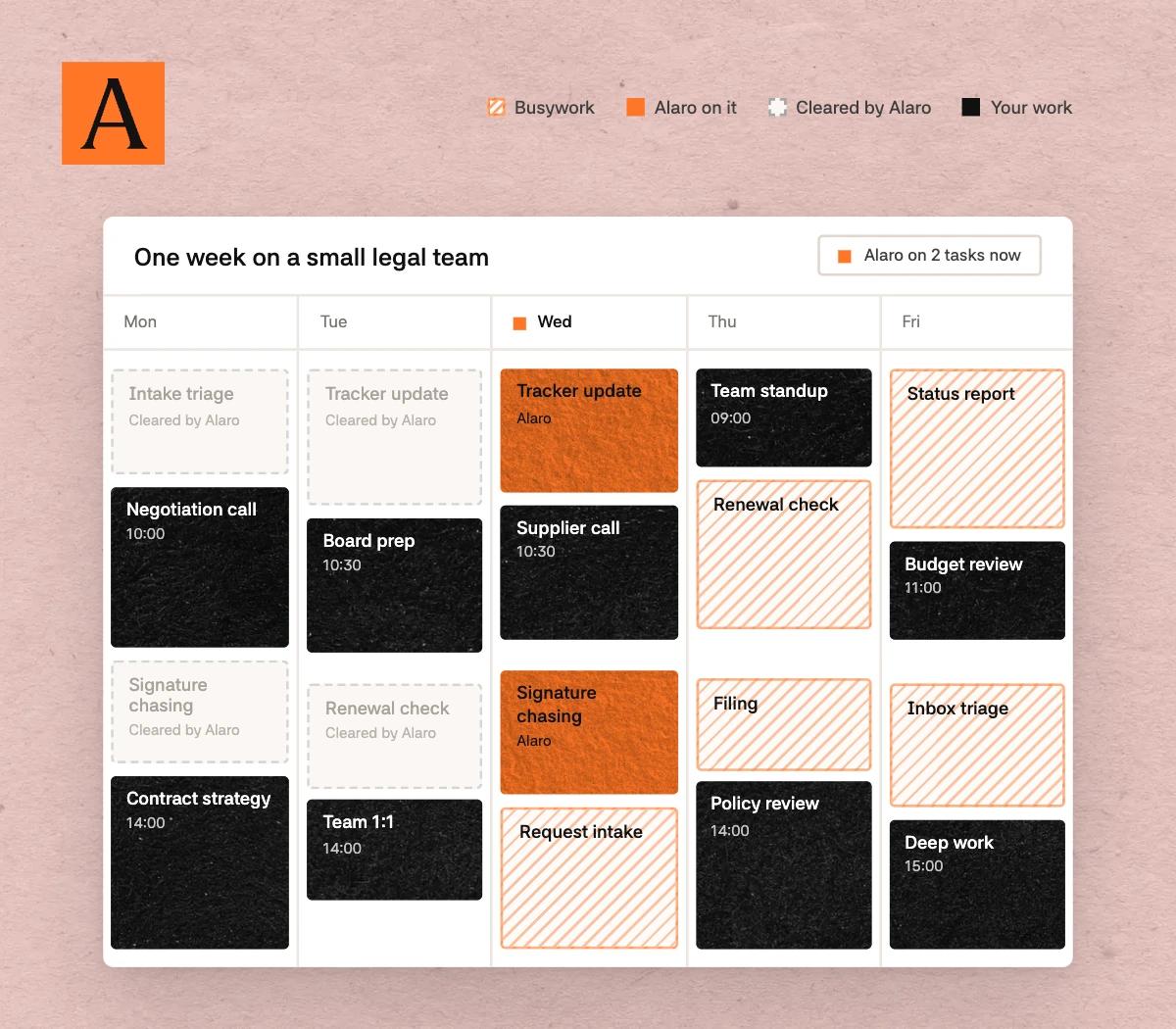
Most small teams already cope with all of this. The question is who carries it. Take one week on a two-lawyer team, with a customer order form in by email and a supplier agreement in Slack.
None of this removes the judgment. Decisions about strategy, risk and approval stay with you, and Alaro asks when instructions are missing or a request falls outside the rules you have set.
Alaro works in the tools your team already uses, including email, Slack, Teams, Word and DocuSign. Our integrations directory lists the rest.
You can start for free and send Alaro one task. You do not need a kickoff call or a fully documented workflow first. To learn more, read what Alaro is and how it works or what an AI paralegal is.
FAQ
What is the difference between legal ops and a paralegal?
Legal ops designs how the team works, from intake and tracking to budgets, vendors and tools. A paralegal does the work that moves through that system, such as drafting, checking, chasing and filing. On a small team, one person often does both.
Which metrics should a small legal team track?
Start with three. Count how many requests came in, how long they took to close and how much went to outside counsel. Add another only when someone will act on it.
Can a team of one run legal ops?
Yes. A sole general counsel can run one place for requests, one tracker and a one-page playbook. The aim is fewer interruptions and less held in one person's head.
Sources
- Thomson Reuters Institute and Buying Legal Council, 2025 Legal Department Operations Index, September 24, 2025. Figures are from the report's "By the numbers" infographic.
- Association of Corporate Counsel and FTI Consulting, 2026 ACC Chief Legal Officers Survey: Key Findings, January 2026.
- Corporate Legal Operations Consortium, What is Legal Ops?, read November 17, 2026.
- Corporate Legal Operations Consortium, Core 12, read November 17, 2026.
- Sterling Miller for Thomson Reuters, Driving legal process improvement and productivity through legal operations, August 12, 2026.