Know your business, or KYB, is the mandatory due diligence and compliance process that firms use to verify the identity, structure and legitimacy of their corporate clients. Any business can run the same check on a supplier or partner before it signs, largely from the public record.
This article provides general information only and does not constitute legal advice. What a business must check about another company depends on its sector, the facts and the jurisdiction concerned.
What does 'know your business' mean?
Know your business means confirming that a company is real, who is behind it and whether anything about it warrants a double-take. It is the company version of know your customer (KYC), which asks the same questions of a person.
Banks, payment firms and other regulated businesses run KYB checks under anti-money-laundering rules. Those rules differ by country and by sector, and regulated firms have obligations of their own on top of what is described here.
The everyday version of know your business is simpler. Before you sign with a company you have not dealt with before, a KYB check answers one plain question: Is this the company we think it is?
What does a KYB check look at?
Commonly, six things. Each one answers a question about the company.
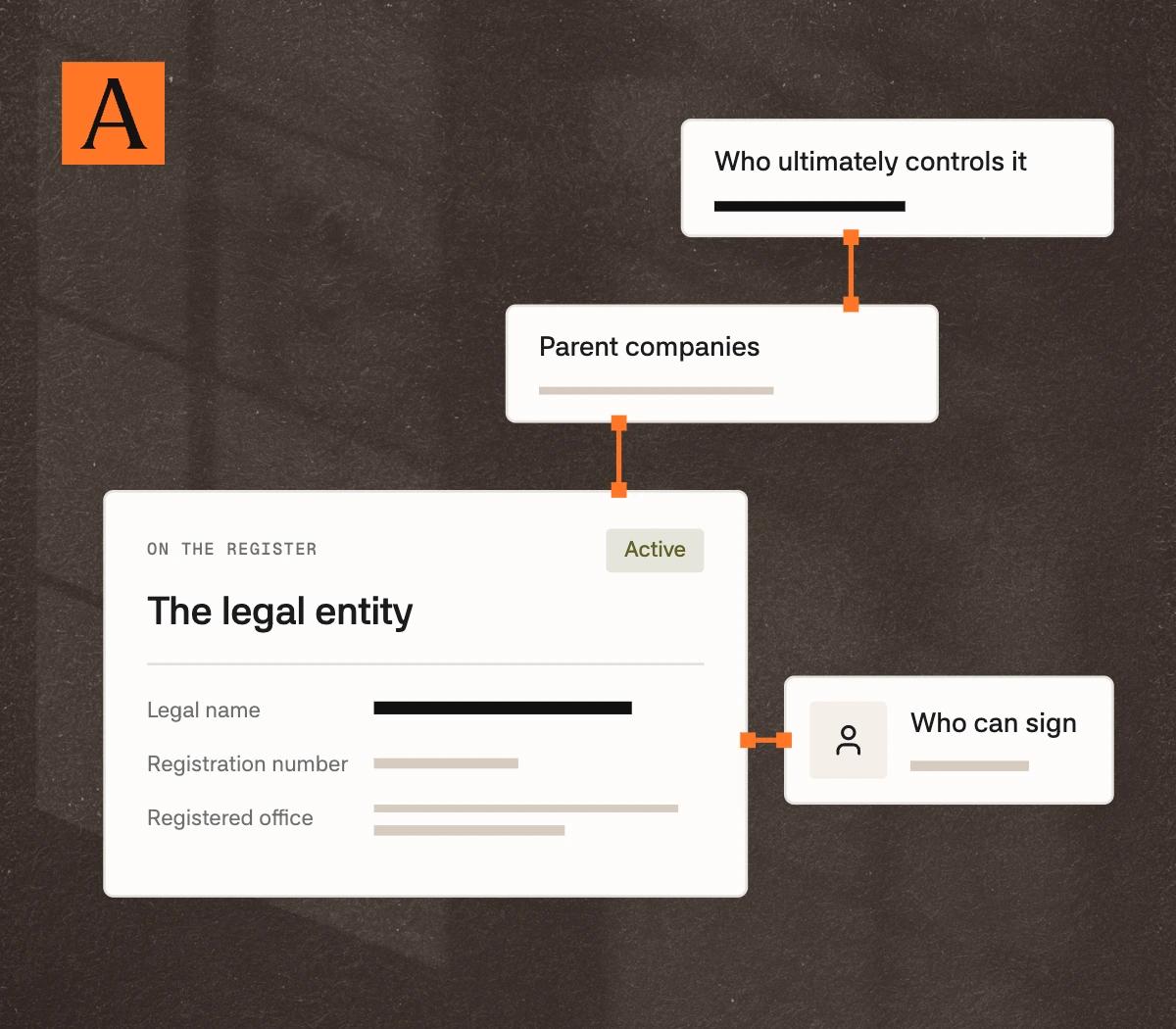
- The legal entity. The exact legal name, registration number, registered office and any former names. A brand or a trading name is often different from the company that signs.
- Status and standing. Whether the company is active, whether its accounts are filed on time, and whether a charge or an insolvency notice is registered against it.
- Ownership and control. Who owns the company, through which parent companies, and who ultimately controls it; whether through shares, voting rights or the power to appoint or remove its directors.
- Who can sign. The current directors and officers, as a first check on who can sign.
- Sanctions and disqualifications. Whether the company, its owners or its directors appear on a sanctions list or a register of disqualified directors.
- The match. Whether the name, number and address in the contract are the ones on the register. Later, the same goes for the invoice. A VAT number can be checked against the name and address it is registered to.
Here's the catch. Screening only the company's name can miss an owner who is on a list. That is why the check settles ownership before it screens.
Where does the public information for a KYB check come from?
Mostly from official registers, and many of them are free to search. Which register depends on where the company was formed.
Take the UK. One free search at Companies House returns the registered address, current and resigned officers, filed documents, charges, previous names and insolvency information. A separate search covers disqualified directors.
Elsewhere, the national register is the usual starting point. The business registers of every EU country have been searchable in one place, the European e-Justice Portal, since June 2017.
One identifier works across borders. Some companies, in any country, carry a Legal Entity Identifier, a 20-character code issued under a global standard. Its record is built to answer who is who and who owns whom.
What can the public record not tell you?
A register shows what a company has filed, and that has limits. Three are worth knowing before you rely on one.
Much of it is the company's own word. A register entry is a statement by the company. Companies House began requiring directors and people with significant control to verify their identity in November 2025.
Ownership has a threshold. The UK register usually lists anyone with more than 25% of the shares or voting rights. An owner with a smaller stake may not appear.
Ownership is not public everywhere. US companies register with a state, and there is no public federal register of owners.
What happens when the record has a gap? In our view, the check should report it.
A careful check says what it could not confirm as plainly as what it found. An ownership chain that stops at an overseas holding company is a finding, and the person deciding should see it.
How deep should a KYB check go?
As much as the contract warrants. The depth follows the value and the risk, and no one level suits every company.
A small one-off order may need only the legal entity and its status. A company that will hold your data, take a large payment up front, buy from you on credit or become hard to replace usually deserves every line.
How does Alaro check a company before you sign?
Alaro is a self-serve AI paralegal, built by lawyers. Send it a company name or the contract by email, Slack, Teams or WhatsApp, and it checks each party at the source.
- The registers. Alaro reads Companies House, company registers in other countries and any databases you already subscribe to.
- What comes back. Status, accounts, officers, charges and who ultimately owns the company, with anything unusual first. For a Companies House check, the filed documents come attached.
- The contract. Alaro checks that the party named in the draft matches the register.
- The decision. Alaro reports what the register shows and flags what looks out of place. Whether to go ahead stays with you.
If your business is regulated, the checks your own rules call for stay with your compliance team.
Know your business also runs the other way. When a customer or a bank checks your company, Alaro fills in the KYC and onboarding forms from your existing answers and records.
Our in-house lawyers monitor quality and double-check work that is escalated internally. If a check raises a question you want advice on, ask for a specialist review by a regulated, insured lawyer. You approve the scope and fee first.
You can start free and send Alaro one company name.
FAQ
What is the difference between KYB and KYC?
KYC, or know your customer, checks a person. KYB checks a company, and it usually includes identifying the people who own and control that company. The two overlap wherever a company's owners or directors are checked as individuals.
Is a KYB check the same as vetting a supplier?
No. A KYB check confirms who the company is and who is behind it. Vetting a supplier also asks whether it can do the job, which covers areas including security, insurance, references and financial resilience, among others.
How often is a KYB check repeated?
A check describes one day. Common moments to run it again are a renewal, a change of name or owner, and a request to pay a new bank account. Companies House also offers free email alerts when a company you follow changes its details.
Sources
- Companies House, Get information about a company, GOV.UK, read November 18, 2026.
- Companies House, Verifying your identity for Companies House, GOV.UK, published March 18, 2025, updated June 1, 2026.
- Companies House, People with significant control (PSCs), GOV.UK, published November 9, 2020, updated July 30, 2026.
- GOV.UK, Search the register of disqualified company directors, read November 18, 2026.
- HM Revenue & Customs, Check a UK VAT number, GOV.UK, read November 18, 2026.
- Foreign, Commonwealth & Development Office, The UK Sanctions List, GOV.UK, updated November 17, 2026.
- US Department of the Treasury, Office of Foreign Assets Control, Sanctions List Search tool, read November 18, 2026.
- Financial Crimes Enforcement Network, Beneficial Ownership Information Reporting, read November 18, 2026.
- National Association of Secretaries of State, Corporate Registration, read November 18, 2026.
- California Secretary of State, Uniform Commercial Code, an example of a state's public UCC filings, read November 18, 2026.
- European e-Justice Portal, Business registers: search for a company in the EU, read November 18, 2026.
- Global Legal Entity Identifier Foundation, Introducing the Legal Entity Identifier (LEI), read November 18, 2026.
- UK legislation, The Money Laundering, Terrorist Financing and Transfer of Funds (Information on the Payer) Regulations 2017, regulation 28, legislation.gov.uk, read November 18, 2026.
- Financial Crimes Enforcement Network, Information on Complying with the Customer Due Diligence (CDD) Final Rule, read November 18, 2026.
- US Securities and Exchange Commission, Schedules 13D and 13G, Investor.gov, read November 18, 2026.