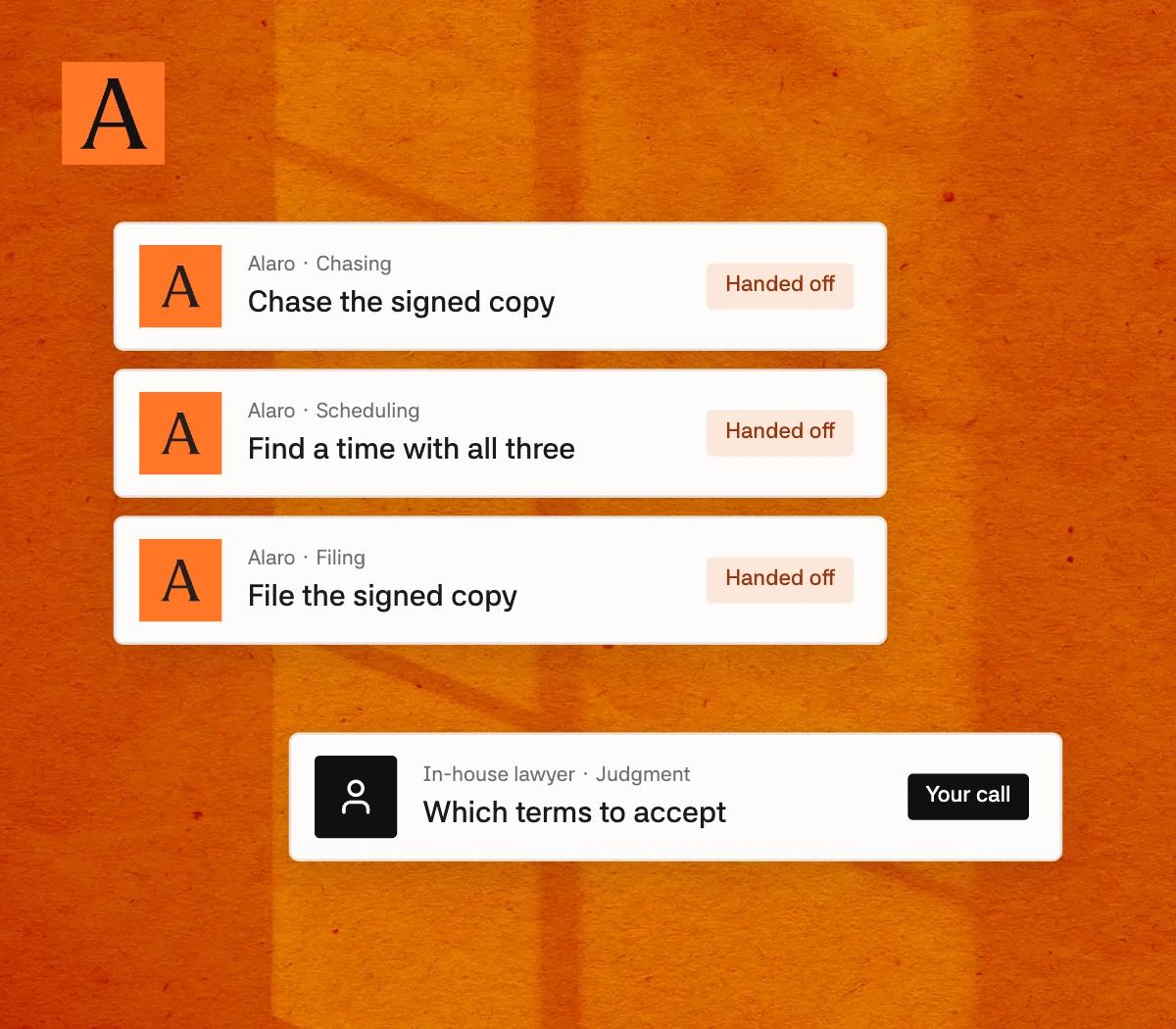
For an in-house lawyer, the week tends to split between work that needs a lawyer's judgment and the routine around it, including catching up on emails, chasing counterparties, scheduling calls and filing.
What does an in-house lawyer do?
An in-house lawyer advises the business on legal questions and helps it manage risk. In practice, the job reaches well beyond advice.
The work usually includes these areas, among others.
- Contracts. Drafting, reviewing and negotiating the agreements the business runs on.
- Everyday questions. Quick answers for colleagues in sales, finance, HR and operations.
- Compliance. Keeping the business in line with the rules that apply to it.
- Governance. Board papers, company records and filings.
- Disputes and outside counsel. Managing claims, and instructing law firms when specialist help is needed.
At the top of the team, the role often reaches further. In a 2026 survey of chief legal officers, most also oversaw compliance and the corporate secretary function.
The work also arrives from every direction. The Solicitors Regulation Authority reviewed in-house teams in England and Wales in 2023. It found instructions coming from employees at any level of the organization, as well as from the chief executive.
How does an in-house lawyer's job differ from a law firm lawyer's?
An in-house lawyer works inside the business they advise, and that changes the job. A law firm lawyer is often brought in for a defined piece of work. An in-house lawyer is there before the question is asked and after the answer is given.
So the work is broader. It follows whatever the business does next, well beyond one specialism. A single day can hold a supplier contract, a board paper and a question from HR.
It is also closer to the decision. Colleagues want to know what the business should do, and the legal answer is only part of that. There is no engagement letter to mark where the job stops.
Where does the week tend to go?
To two kinds of work. One is the judgment the business hired a lawyer for. The other is the routine that surrounds every piece of it.
Take one supplier contract. The judgment is deciding which terms to accept and where to push back.
Around that decision sit the emails to the other side, the chaser to finance and the calls to schedule. Then come the signatures to collect and the signed copy to file. Each task is quick to describe and slow to finish.
Together they add up. In a 2021 survey, 1,000 law department leaders reported that one in every five in-house counsel hours went to repetitive or routine tasks. Across a five-day week, that is a full day.
Workload is where the strain shows. In the regulator's review of in-house teams, 62% of the solicitors surveyed said managing workloads was their biggest challenge.
Our view is simple. The routine matters, and it has to be done well.
However, it does not have to be done by the lawyer.
Which parts of the week can be handed off?
The parts that follow a pattern and come back for approval. Work that hands off well tends to share three features.
- It repeats. The same kind of email, form or chaser comes up week after week.
- The instruction fits in a line. "Chase the signed copy" or "find a time with all three" is the whole brief.
- It is easy to check. A draft can be read before it goes out, and a meeting is either booked or it is missing.
What stays is the work that needs the lawyer. That includes the advice itself, the call on risk, the negotiating position and the final approval, among others.
Who takes on the routine depends on the team. It might be a paralegal, a legal assistant, a colleague in the business or an AI paralegal.
Either way, the lawyer still decides. Someone else does the legwork before and after the decision.
How does Alaro take on the routine parts of the week?
Alaro is a self-serve AI paralegal, built by lawyers. Copy Alaro in on a thread, or forward it with a line of instruction. It takes on the everyday emails and admin around your legal work.
You decide what Alaro sends on its own and what waits for your approval. Alaro uses your tone, your sign-off and your usual copy list. It asks when instructions are missing or a request falls outside the rules you have set.
Alaro works where requests already arrive, by email, Slack, Teams or WhatsApp. It also works with tools including Outlook, Gmail, Google Calendar and DocuSign, and our integrations directory lists the rest.
Our in-house lawyers monitor quality and double-check work that is escalated internally. When you want that, ask for a specialist review by a regulated, insured lawyer, with the scope and fee approved by you first.
You can start for free and copy Alaro in on the next thread you are chasing. To learn more, read what Alaro is and how it works.
FAQ
What is the difference between an in-house lawyer and a general counsel?
A general counsel is the most senior in-house lawyer in an organization and leads its legal team. In a small company, the general counsel may be the only lawyer.
Is in-house counsel the same as an in-house lawyer?
Yes. Both describe a lawyer employed by the organization they advise. Corporate counsel and in-house solicitor are used the same way, and the usual term varies by country and company.
Which task is a good one to hand off first?
One that is quick to describe and slow to finish. Filing a signed copy, chasing an approval and booking a call for six people are common places to start. Each is easy to check, so trust can build one task at a time.
How much time can an in-house lawyer save by handing off routine work?
In a 2025 survey, 2,275 professionals, lawyers among them, predicted AI would save them five hours a week on average within a year. That is more than 200 hours a year.
Sources
- Solicitors Regulation Authority, In-house solicitors thematic review, March 14, 2023.
- EY Law and Harvard Law School Center on the Legal Profession, The General Counsel Imperative: How do you turn barriers into building blocks?, May 2021.
- Association of Corporate Counsel, 2026 ACC Chief Legal Officers Survey: Key Findings, January 2026.
- Thomson Reuters, The AI Adoption Reality Check (press release for the 2025 Future of Professionals report), June 26, 2025.