A due diligence report tends to arrive when a deal is at its busiest. You may be buying a company, raising money or selling the business you built, and a long document from the lawyers and accountants lands days before a decision.
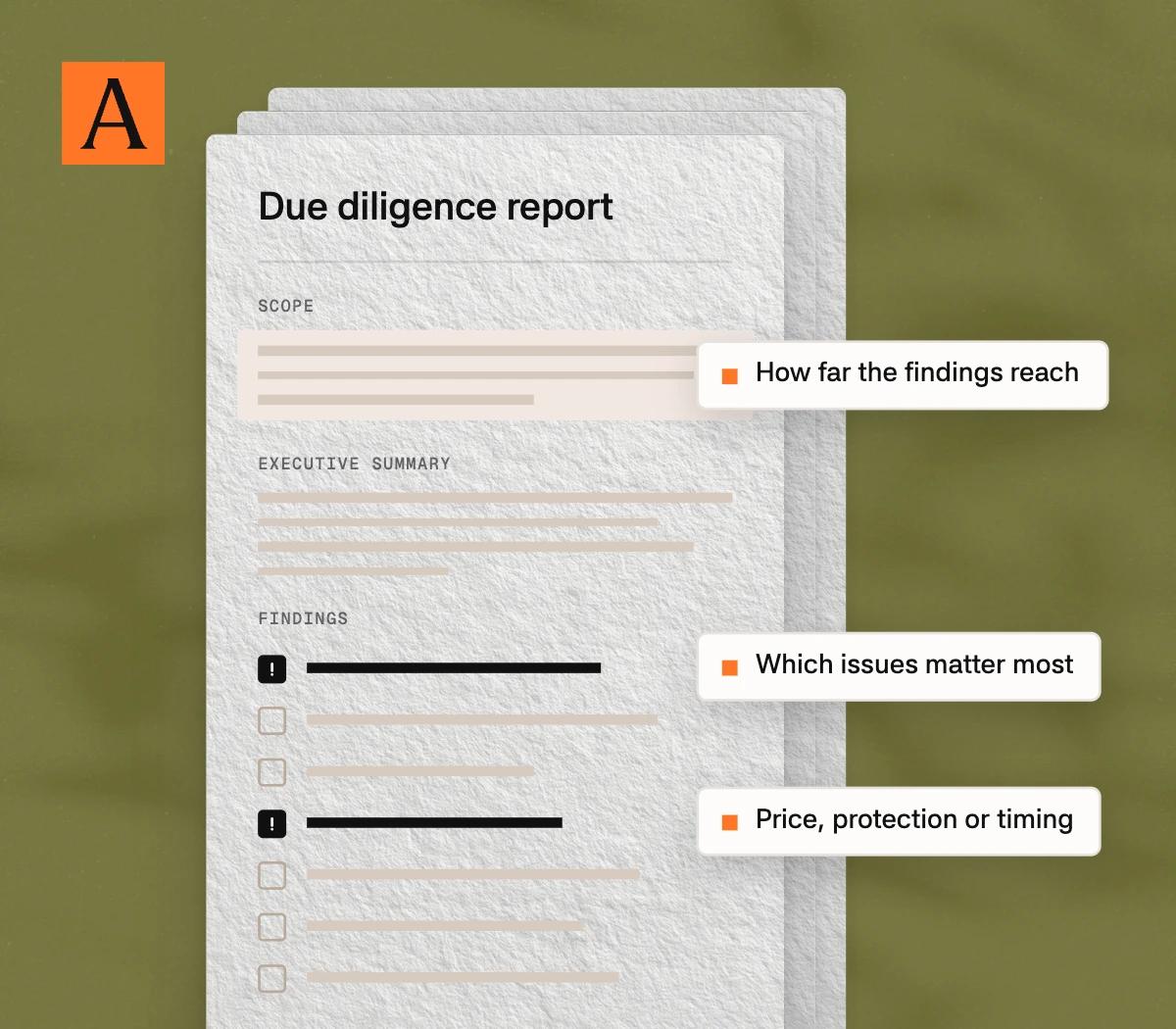
You do not have to read it the way its authors wrote it. Read it for three things: how far the findings reach, which issues matter most, and whether each one changes the price, the protections in the agreement or the timing.
This article provides general information only and does not constitute legal advice. How a finding should be handled on a particular deal depends on the facts, the agreement and the jurisdiction concerned.
Where should you start in a due diligence report?
Start with the pages that are easiest to skip. A legal report is usually divided into four parts, and the first is a section of disclaimers. It sets out the agreed scope, the sources the reviewers used and what they assumed.
Those pages decide how to read everything after them. Unless a report says otherwise, its findings come from the documents the seller disclosed. The reviewers took those documents to be genuine and complete.
Then read the executive summary, which runs to a few pages and leaves the detail to the main report.
It is also worth checking which version you hold. A preliminary report typically arrives when about 80 percent of the information has been reviewed, and the final one replaces every earlier note and email.
What does a due diligence report not tell you?
More than its length suggests. A due diligence report answers the questions its scope asked, on the documents available by its cut-off date.
Scope is a choice. The advisers who write the report (usually lawyers and accountants) recommend one, and the client is responsible for what is covered and what is left out. Time, cost and the size of the deal all shape it, so two careful reports on the same company can look different.
A section with no findings is not always good news. It can mean the reviewers found no problems, or that they were never given the documents for that area. Ask which it was, because only the first is reassuring.
Summaries lose detail too. Boards and investment committees often receive a synopsis of the findings, and a synopsis will not carry every point that matters. If a decision rests on one issue, the full finding is worth reading.
How do you weigh a finding?
Ask three things of it. How likely is the problem, what would it cost, and can it be fixed before signing?
A report can usually answer part of that. It can tell you that a customer contract needs consent before a sale. Whether that customer will give it is a judgment about the relationship, and it sits with the people who know the customer.
Ratings help, with one caution. High, medium and low are the authors' own scale, and the legal and financial teams may not measure the same way. A finding with no figure beside it is not necessarily a small one. It may only be hard to estimate.
For the two or three findings that drive the deal, it is worth following the reference back to the document. A good report makes that a short job.
What if your company is the one being examined?
Then you will probably not see the due diligence report. A buyer's report is not usually shared with the target's management, apart from extracts sent to confirm the facts.
What you see are the questions. Lists arrive in rounds, and each round shows where the reviewers are looking. Later, the findings come back to you as requests on price, warranties and conditions.
Two things are in a seller's hands. One is time, because answering takes a real share of the management team's weeks. The other is order. We think a problem you already know about is easier to fix, or to explain, before a reviewer finds it.
Some sellers go further and commission a report on their own business to share with bidders. It is known as a vendor due diligence report.
How does Alaro help with a due diligence report?
Alaro is a self-serve AI paralegal, built by lawyers. For a team that has to produce a report, or keep one current, it takes on the reading and the drafting.
Give Alaro access to the data room, on Datasite, Egnyte, Google Drive or wherever the documents live. It reads every document and writes the report in your format, issues first, with each finding traced to the document and page it came from.
It also lists what should be in the data room and is missing, and drafts the questions for the seller for your approval. The conclusions stay with you.
When the questions are coming to your company, Alaro helps there too. It answers a due diligence questionnaire (a DDQ) from your records and past responses, with the source noted against each answer, and comes back to you only for what is new. On a deal, it also tracks who is answering each question, what has gone back and what still needs a follow-up.
If a report you have been sent runs long, Alaro can turn it into one page, with every point linked back to its source.
Our in-house lawyers monitor quality and double-check work that is escalated internally. That is different from a lawyer reviewing your particular matter. When you want that, ask for a specialist review by a regulated, insured lawyer, with the scope and fee approved by you first.
A data room is confidential, and the same page explains how we protect what you share. You can start free and give Alaro access to your next data room.
FAQ
What is the difference between a red flag report and a full due diligence report?
A red flag report covers only the issues serious enough to affect the deal. A full due diligence report describes the business area by area, including the parts that raise no concern. The format is usually agreed with the client before the review starts.
Is a due diligence report the same as an audit?
No. Financial due diligence does not verify the numbers in the way an audit does, and it gives no formal opinion on them. A legal report is a review of the documents disclosed, and it is not a legal opinion. Reports usually say so in their opening pages.
Can you rely on a due diligence report written for someone else?
A report is prepared for the client who commissioned it, for one deal. Lenders and insurers often ask to see it, and its authors usually set the terms on which they may read or rely on it. Written to someone else's scope, it may not answer a later reader's questions.
Sources
- International Bar Association, Corporate and M&A Law Committee, Legal Due Diligence Guidelines, September 2018. The link goes to a copy hosted on a law firm's website (Delaware Counsel Group), because the publisher's own copy was not found.
- ICAEW Corporate Finance Faculty, Best-Practice Guideline 71: Financial Due Diligence, written by PricewaterhouseCoopers LLP, UK, 2024.