A good contract review checklist is a set list of questions to ask of any contract before you sign it. It decides when a contract falls outside your standard positions, the ones a playbook records.
The same list should work for supplier agreements, MSAs, order forms and renewals, whoever in the business picks them up.
Why do commercial terms carry the most weight?
Because they decide whether the contract works. Most negotiating time goes to a few risk clauses, and other terms tend to decide how the deal turns out.
In a 2026 survey, limitation of liability, price and indemnification were the most negotiated terms. The terms most closely tied to performance and disputes, including scope, delivery and service levels, often received less attention.
Our view is simple. A checklist that gives a page to the liability cap and a line to governance has its weight in the wrong place. A good checklist gives equal weight to every point in your playbook, including service levels, change control and termination rights, among others.
What should a good contract review checklist cover?
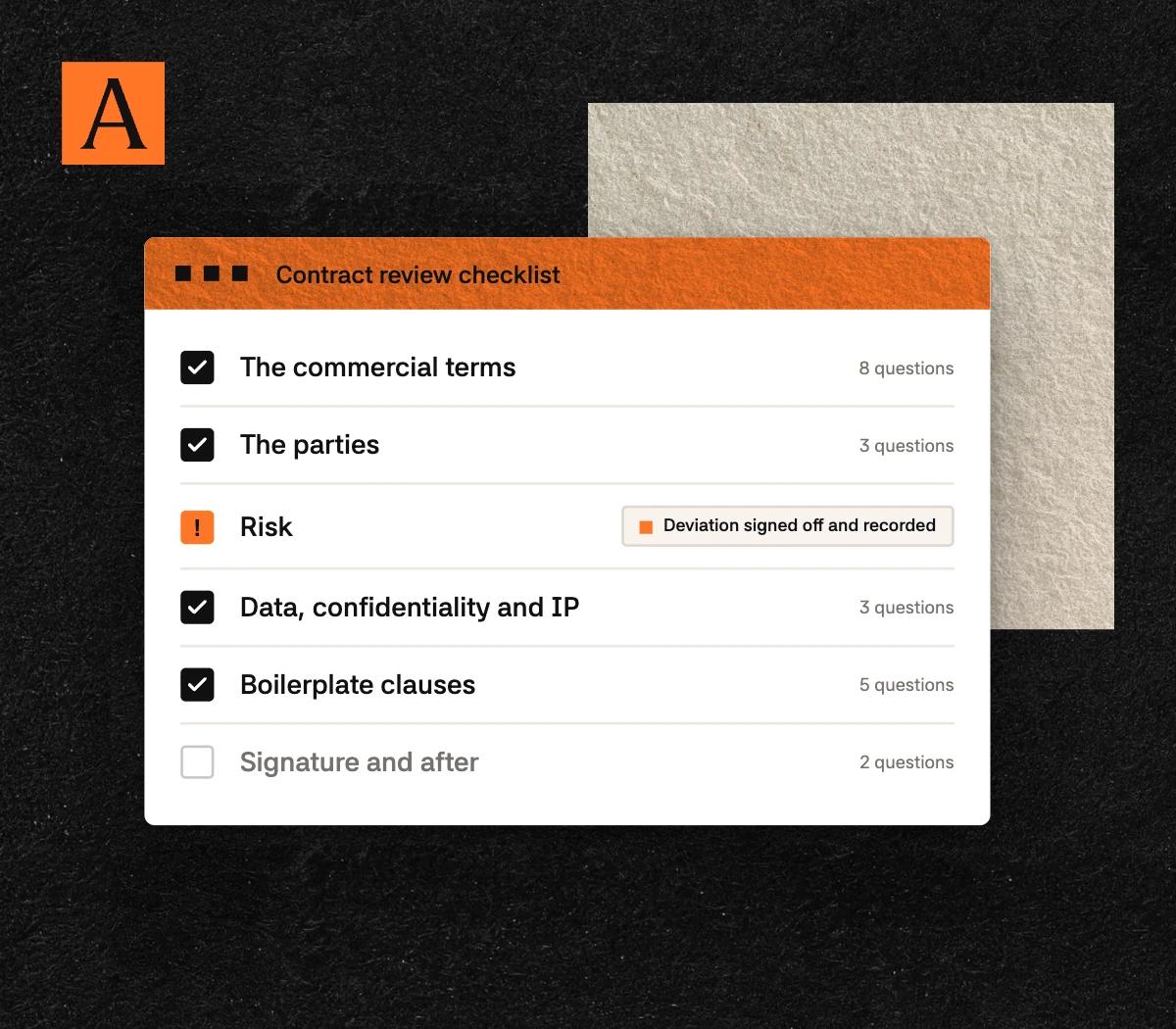
Six groups, with the commercial terms first and in the most detail. Each line is a question a good checklist asks.
The commercial terms
- Scope. What is delivered, by when and to what standard, with every schedule attached.
- Acceptance. How delivery is accepted, and what happens if it is rejected.
- Service levels. What is promised about performance, how it is measured, and the remedy if it falls short.
- Governance. How performance is reviewed, how changes are agreed and how problems are escalated.
- Price. The fees, what they include, and whether they can rise during the term or at renewal.
- Payment. When invoices are due, and what a late payment costs.
- Term and renewal. The length, whether it renews automatically, and the last day to give notice.
- Termination. Who can end the contract, on what grounds, with how much notice, and what is owed when it ends.
The parties
- Legal entities. Each party's full legal name, matched to the company you are dealing with.
- Authority. Whether the signer can bind their company, and whether your own approval rules were followed.
- Order of documents. Which document wins if the order form, the terms and a schedule disagree.
Risk
- Limitation of liability. Whether there is a cap, how it is measured, and what falls outside it.
- Indemnities. Who covers whose losses, for which events, and whether those promises sit inside the cap.
- Warranties. What each side promises, and the remedy if a promise is broken.
- Insurance. The cover the contract requires, and evidence that it is in place.
Data, confidentiality and IP
- Personal data. Whether personal data is handled under the contract, and whether the terms that the law requires are in place.
- Confidentiality. What each side must keep confidential, and for how long.
- Intellectual property. Who owns what is created under the contract, and what each side may use during and after the term.
Boilerplate clauses
- Governing law and disputes. Which law applies, and whether disputes go to court or arbitration, and where.
- Assignment and change of control. Whether either side can transfer the contract, and what happens if one party is acquired.
- Restrictions. Any exclusivity, minimum commitment or non-compete that limits what the business can do.
- Changes and notices. How the contract can be amended, and where formal notices must be sent.
- Survival. Which obligations continue after the contract ends.
Signature and after
- The signature copy. Whether it matches the last draft both sides approved, with every attachment. Our final checks page has the full list.
- After signature. Where the signed copy is filed, and who holds the renewal and notice dates.
How does a good checklist help the negotiation?
It tells you what to ask for before the first call.
For every term, a good checklist records your standard position, the fallback you will accept and who approves anything beyond it. At that point the checklist has become a playbook.
A good checklist also keeps a record. Every deviation from a standard position is signed off by the person who can approve it, and that approval is recorded.
The idea is not new. One college's single-page checklist from 2007 asks three things of every clause. Is it included, was the approved wording used, and who approved any change?
Does every contract need the full checklist?
No. A good checklist is sized to the contract, with the depth of the contract review process matched to value and risk.
A low-value order on your own standard terms may need little more than the commercial terms and the final checks. A contract on the other side's paper usually deserves every line. So does one that involves personal data, a large commitment or exclusivity.
How does Alaro use your checklist?
Alaro is a self-serve AI paralegal, built by lawyers. Once your checklist carries your own positions, it is the playbook Alaro reads every contract against.
Send Alaro your playbook and templates as they are, and it fills the gaps from your past deals. No playbook yet? It can build one from the way you already negotiate.
From then on, send each contract by email, Slack, Teams or WhatsApp. Alaro flags anything outside your playbook and never changes it quietly.
The same positions carry into the negotiation. Alaro counters the other side's redline inside your limits and brings you in when an ask goes beyond them.
Our in-house lawyers monitor quality and double-check work that is escalated internally. That is different from a lawyer reviewing your particular contract. When you want that, ask for a specialist review by a regulated, insured lawyer, with the scope and fee approved by you first.
You can start free and send Alaro one contract.
FAQ
Who should review contracts when there is no in-house lawyer?
Someone who knows the deal, working from a written contract review checklist, with clear rules on when to ask a lawyer. In a small company that is often someone in finance or operations. The checklist handles the routine points, and the escalation rules cover the rest.
What changes when the other side insists on its own template?
The checklist stays the same, and the review takes longer, because nothing in the template starts from your positions. A good checklist also asks what is missing, since a template written by the other side may leave out protections you would have included.
What is the difference between a contract review and a redline?
A review is reading the contract and deciding what needs to change. A redline is the marked-up draft that shows those changes to the other side, usually as tracked changes. The checklist guides the review, and the redline records its result.
Sources
- Commerce & Contract Management Institute, Most Negotiated Terms 2026: The conflicts and confusions of the modern negotiator (report page; published in collaboration with Sirion), October 29, 2026.
- Smith College, The Contract Review Checklist, September 2007.